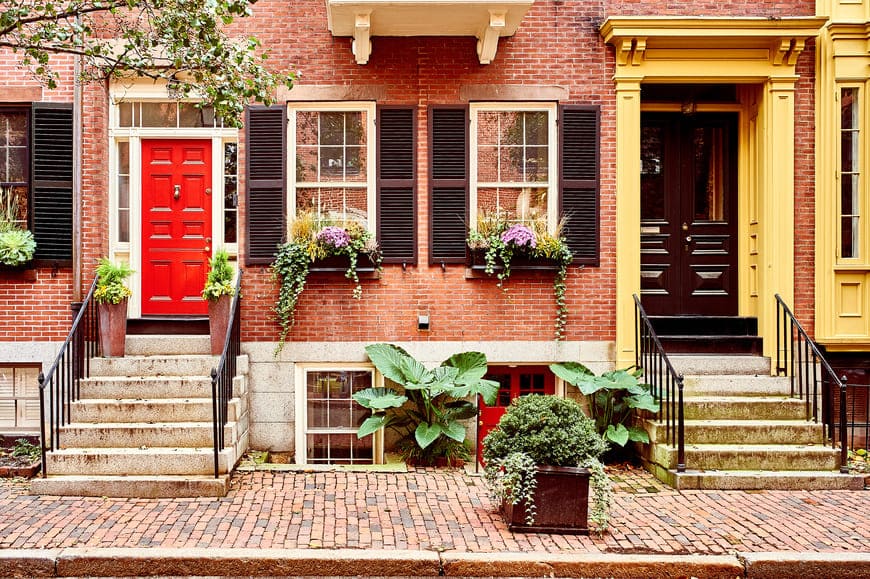
Beacon Hill is the historic residential neighborhood that rises north of Boston Common, between the Massachusetts State House and the Charles River. Its brick sidewalks, gas lamps, and Federal and Greek Revival rowhouses make it one of the best preserved early 19th-century neighborhoods in the country, and nearly all of it lies within the Historic Beacon Hill District.
The neighborhood takes its name from the beacon that once stood on its summit to warn of invasion. It was one of three peaks, the Trimountain, that gave Tremont Street its name. Development began with Charles Bulfinch's new State House, completed in 1798, and with the Mount Vernon Proprietors, one of the earliest land development companies in the United States, who bought land west of the State House for house lots. Over the following decades the hilltop was cut down and the earth used to fill the shoreline, creating the level Flat of the Hill along Charles Street. Architects including Bulfinch, Asher Benjamin, and Alexander Parris designed homes here in the Federal and Greek Revival styles.
Beacon Hill is usually described in three parts: the South Slope facing the Common, the North Slope running down to Cambridge Street, and the Flat of the Hill near the river. The North Slope was the center of Boston's 19th-century Black community, and the African Meeting House on Smith Court, built in 1806, is now part of the Boston African American National Historic Site and the Black Heritage Trail. In 1955 the state created the Historic Beacon Hill District, the first such district in Massachusetts, and exterior changes visible from a public way still require review. The neighborhood borders Boston Common and Midtown to the south, the West End across Cambridge Street, and Downtown to the east, with Back Bay across the Public Garden.
Charles/MGH station on the Red Line sits at the foot of the hill by the Longfellow Bridge, Park Street station connects the Red and Green lines at the corner of the Common, and Bowdoin station on the Blue Line is on the eastern edge. Storrow Drive runs along the river, and Downtown Crossing and Government Center are a short walk away.
Most homes on Beacon Hill are brick rowhouses from the first half of the 19th century, many now divided into condominiums, along with whole townhouses, later apartment buildings, and a few converted carriage houses and stables. Louisburg Square, surveyed in the 1820s and built up between 1834 and 1847, is lined with Greek Revival townhouses around a private park maintained by its proprietors. Acorn Street, a narrow cobblestone lane, is among the most photographed streets in Boston.
Beacon Hill buildings on our site include:
Charles Street is the neighborhood's main street, with antique shops, cafes, restaurants, and everyday services, and Cambridge Street adds more along the northern edge. Boston Common and the Public Garden are across Beacon Street, and the Charles River Esplanade is reached by footbridge from the Flat of the Hill. The State House, the Robert Gould Shaw and 54th Regiment Memorial, and the Black Heritage Trail draw visitors year round.
What kinds of homes are on Beacon Hill?
Mostly brick rowhouses from the first half of the 19th century, many divided into condominiums, along with whole townhouses, later apartment buildings, and a few converted carriage houses and stables.
How do you get around from Beacon Hill?
Charles/MGH station on the Red Line sits at the foot of the hill, Park Street connects the Red and Green lines at the corner of the Common, and Bowdoin on the Blue Line is on the eastern edge. Downtown Crossing and Government Center are a short walk away.
Are there rules for changing a Beacon Hill home's exterior?
Yes. Nearly all of Beacon Hill lies within the Historic Beacon Hill District, created by the state in 1955 as the first such district in Massachusetts, and exterior changes visible from a public way still require review.
To see homes for sale in Beacon Hill, browse the listings below. Thinking of buying or selling in Beacon Hill? Call (617) 848-9616 or get a free home valuation. Beacon Hill is part of our Boston neighborhood guide.
8,232 people live in Beacon Hill, where the median age is 40 and the average individual income is $152,063. Data provided by the U.S. Census Bureau.
Total Population
Median Age
Population Density Population Density This is the number of people per square mile in a neighborhood.
Average individual Income
There's plenty to do around Beacon Hill, including shopping, dining, nightlife, parks, and more. Data provided by Walk Score and Yelp.
Explore popular things to do in the area, including Seaport Bar & Grille, Liza Carty Designs, and Paley Bruce PHD.
| Name | Category | Distance | Reviews |
Ratings by
Yelp
|
|---|---|---|---|---|
| Dining | 0.19 miles | 0 reviews | 0/5 stars | |
| Shopping | 0.19 miles | 0 reviews | 0/5 stars | |
| Active | 0.37 miles | 0 reviews | 0/5 stars | |
| Beauty | 0.19 miles | 0 reviews | 0/5 stars | |
| Beauty | 0.19 miles | 0 reviews | 0/5 stars | |
| Beauty | 0.22 miles | 8 reviews | 3.5/5 stars | |
|
|
||||
|
|
||||
|
|
||||
|
|
||||
|
|
||||
|
|
Beacon Hill has 5,073 households, with an average household size of 1. Data provided by the U.S. Census Bureau. Here’s what the people living in Beacon Hill do for work — and how long it takes them to get there. Data provided by the U.S. Census Bureau. 8,232 people call Beacon Hill home. The population density is 51,450 and the largest age group is Data provided by the U.S. Census Bureau.
Total Population
Population Density Population Density This is the number of people per square mile in a neighborhood.
Median Age
Men vs Women
Population by Age Group
0-9 Years
10-17 Years
18-24 Years
25-64 Years
65-74 Years
75+ Years
Education Level
Total Households
Average Household Size
Average individual Income
Households with Children
With Children:
Without Children:
Marital Status
Blue vs White Collar Workers
Blue Collar:
White Collar: