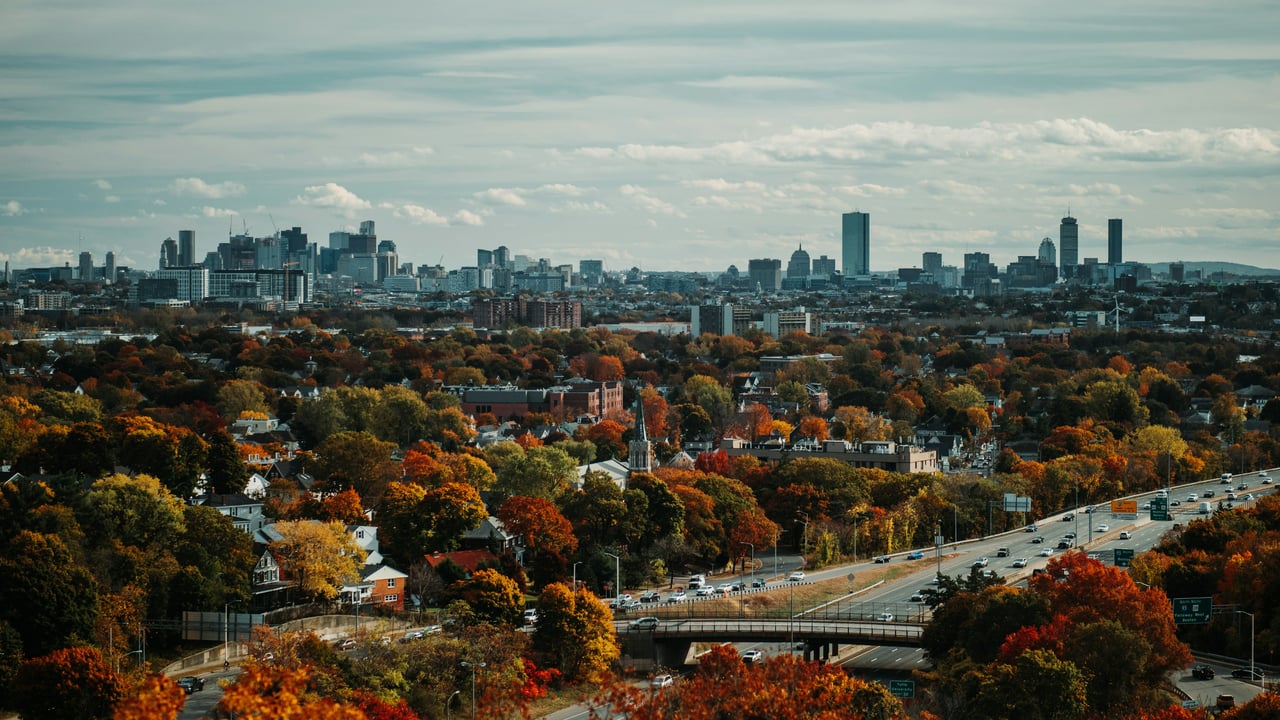
Greater Boston is the region of cities and towns that surrounds the city of Boston, from the dense inner suburbs across the Charles River to colonial towns along Route 128 and the harbor communities of the South Shore. Each has its own village centers and housing, and many are linked to Boston by MBTA subway or commuter rail.
Many of the communities around Boston are as old as the city itself, founded as farming towns in the 1600s and later reshaped by railroads, streetcars, and highways. The closest ring includes Cambridge, home to Harvard University and MIT, along with Somerville and Brookline. Along the Charles River to the west are Watertown, Newton, and Waltham, and the village of Chestnut Hill spans Boston, Brookline, and Newton.
Farther west, Belmont, Weston, Wellesley, and Needham are largely residential towns, while Lexington and Concord are where the first battles of the American Revolution were fought on April 19, 1775, now remembered at Minute Man National Historical Park. North of the city are Arlington, Medford, Malden, Winchester, and the harbor town of Winthrop. To the south are Milton, Dedham, Quincy, where Adams National Historical Park preserves the homes of two presidents, and Hingham on the South Shore.
The Red Line reaches Cambridge, Somerville, and Quincy, the Orange Line runs to Medford and Malden, and the Green Line serves Brookline, Newton, Somerville, and Medford. Commuter rail lines run through Newton, Wellesley, Needham, Dedham, Belmont, Waltham, Weston, Concord, Winchester, and Hingham. Interstates 93, 95, and 90 and Route 128 form the main highway network.
Housing changes as you move out from the city. Cambridge, Somerville, and Brookline mix two- and three-family houses and triple-deckers with brick apartment buildings and newer condominiums near transit. The river towns and the suburbs west and north of Boston are known for single-family homes on village streets, from 19th-century Victorians to mid-century Colonials and newer construction, along with townhouses and condominiums near their centers. Older mill and factory buildings in towns such as Watertown and Waltham have been converted into lofts, and the South Shore adds homes near the harbor. Each town page on our site describes its own housing and neighborhoods in more detail.
Daily life in Greater Boston centers on village squares and town centers, conservation land, and the water. The Charles River and its paths link many of the western communities, the harbor and the Boston Harbor Islands shape life to the south and east, and historic sites, colleges, and town greens are part of the landscape almost everywhere. Boston itself is close at hand for work, dining, and culture.
What kinds of homes are in Greater Boston?
Housing changes as you move out from the city. Cambridge, Somerville and Brookline mix two- and three-family houses and triple-deckers with brick apartment buildings and newer condominiums, while the suburbs west and north of Boston are known for single-family homes, with townhouses and condominiums near their centers.
How do you get to Boston from Greater Boston?
The Red Line reaches Cambridge, Somerville and Quincy, the Orange Line runs to Medford and Malden, and the Green Line serves Brookline, Newton, Somerville and Medford. Commuter rail serves towns including Newton, Wellesley, Needham, Dedham, Concord and Hingham, and Interstates 93, 95 and 90 and Route 128 form the main highway network.
Which communities are part of Greater Boston?
The closest ring includes Cambridge, Somerville and Brookline, with Watertown, Newton and Waltham along the Charles River to the west. Farther out are Belmont, Weston, Wellesley, Needham, Lexington and Concord, with Arlington, Medford, Malden, Winchester and Winthrop to the north and Milton, Dedham, Quincy and Hingham to the south.
To see homes for sale in Greater Boston, browse the listings below. Thinking of buying or selling in Greater Boston? Call (617) 848-9616 or get a free home valuation
93,308 people live in Greater Boston, where the median age is 36 and the average individual income is $86,569. Data provided by the U.S. Census Bureau.
Total Population
Median Age
Population Density Population Density This is the number of people per square mile in a neighborhood.
Average individual Income
There's plenty to do around Greater Boston, including shopping, dining, nightlife, parks, and more. Data provided by Walk Score and Yelp.
Explore popular things to do in the area, including Restaurant 108, Cadeau, and Wright Alexander MD.
| Name | Category | Distance | Reviews |
Ratings by
Yelp
|
|---|---|---|---|---|
| Dining | 0.96 miles | 0 reviews | 0/5 stars | |
| Shopping | 1.41 miles | 0 reviews | 0/5 stars | |
| Active | 0.17 miles | 0 reviews | 0/5 stars | |
| Active | 0.17 miles | 0 reviews | 0/5 stars | |
| Active | 0.45 miles | 0 reviews | 0/5 stars | |
| Active | 0.51 miles | 0 reviews | 0/5 stars | |
| Active | 0.71 miles | 0 reviews | 0/5 stars | |
| Active | 0.71 miles | 0 reviews | 0/5 stars | |
| Active | 0.79 miles | 0 reviews | 0/5 stars | |
| Active | 0.86 miles | 0 reviews | 0/5 stars | |
| Active | 0.9 miles | 1 review | 5/5 stars | |
| Active | 0.9 miles | 0 reviews | 0/5 stars | |
| Active | 1.09 miles | 0 reviews | 0/5 stars | |
| Active | 1.11 miles | 1 review | 5/5 stars | |
| Active | 1.14 miles | 2 reviews | 3.5/5 stars | |
| Active | 1.14 miles | 0 reviews | 0/5 stars | |
| Active | 1.16 miles | 0 reviews | 0/5 stars | |
| Active | 1.21 miles | 2 reviews | 4.5/5 stars | |
| Active | 1.43 miles | 0 reviews | 0/5 stars | |
| Beauty | 0.59 miles | 0 reviews | 0/5 stars | |
| Beauty | 0.8 miles | 6 reviews | 4.8/5 stars | |
| Beauty | 1.43 miles | 11 reviews | 2.9/5 stars | |
| Beauty | 1.45 miles | 0 reviews | 0/5 stars | |
|
|
||||
|
|
||||
|
|
||||
|
|
||||
|
|
||||
|
|
Greater Boston has 41,811 households, with an average household size of 2. Data provided by the U.S. Census Bureau. Here’s what the people living in Greater Boston do for work — and how long it takes them to get there. Data provided by the U.S. Census Bureau. 93,308 people call Greater Boston home. The population density is 25,571 and the largest age group is Data provided by the U.S. Census Bureau.
Total Population
Population Density Population Density This is the number of people per square mile in a neighborhood.
Median Age
Men vs Women
Population by Age Group
0-9 Years
10-17 Years
18-24 Years
25-64 Years
65-74 Years
75+ Years
Education Level
Total Households
Average Household Size
Average individual Income
Households with Children
With Children:
Without Children:
Marital Status
Blue vs White Collar Workers
Blue Collar:
White Collar: