If you're thinking about buying a multi-family home with friends in Boston, the city has a program built for it. The Boston Home Center's Co-Purchasing Housing Pilot gives each eligible household a 0% interest, deferred loan of up to $50,000 for down payment and closing costs when two or three households buy a two- or three-family home together and each one lives in its own unit.
Key takeaways
- Households earning up to 100% of Area Median Income (currently $137,200 for a two-person household) can get up to $50,000. Households up to 135% of AMI ($185,200 for two people) can get up to $35,000.
- The loan is 0% interest and only comes due when you sell, transfer, refinance, or stop living there.
- The property must be a two- or three-family in the City of Boston, with as many empty units as there are buying households.
- Every household must be a first-time buyer, finish CHAPA homebuyer classes, put in 1.5% of its share from its own funds, and sign a co-ownership agreement.
How does Boston's co-purchasing program work?
Boston's co-purchasing pilot pairs a regular first mortgage with a city loan to each household that covers part of the down payment and eligible closing costs, according to the City of Boston. It's run by the Boston Home Center with the Mayor's Housing Innovation Lab.
Here's how the money works under the city's January 2025 program guidelines:
- The city covers up to half of the lender-required down payment, up to 5% of each household's share of the price, plus eligible closing costs like title insurance, inspections, and attorney fees.
- Each household signs its own promissory note and the city records a mortgage to secure it.
- Nobody can walk away from the closing table with cash back.
- The first mortgage must be a 30-year fixed loan from one of the city's approved lenders, and it can't exceed Fannie Mae's general loan limits. For 2026 that's $1,066,250 for a two-family and $1,288,800 for a three-family, according to FHFA.
Household at or below 100% AMI | Household at 101% to 135% AMI | |
|---|---|---|
Income cap (two-person household) | $137,200 | $185,200 |
Max city assistance per household | $50,000 | $35,000 |
Down payment help | Up to 5% of your share of the price | Up to 5% of your share of the price |
Your own minimum contribution | 1.5% of your share | 1.5% of your share |
Interest rate on city loan | 0%, deferred | 0%, deferred |
Income figures are from the City of Boston's program page and change each year. Confirm current limits with the Boston Home Center.
Who qualifies to co-buy a home in Boston with the city's help?
Each household has to qualify on its own: first-time buyer status, income at or below 135% of AMI, and no more than $100,000 in liquid assets, not counting retirement accounts. "First-time" means you haven't owned a home in the past three years.
Each household also has to:
- Complete a CHAPA-approved HB101 homebuyer class, and finish HO201 within 90 days of buying.
- Live in its unit as a primary residence. The guidelines define that as five out of seven days a week.
- Sign a co-ownership agreement before closing that spells out ownership shares, how expenses and repairs get split, and what happens if someone wants out.
A married couple or partners who already share expenses count as one household, not two. If you need help drafting the agreement, the city partners with the Community Dispute Settlement Center on co-ownership agreements.
What kind of Boston property can you buy with the co-purchasing program?
The property must be a two- or three-family home inside the City of Boston, and it must have at least as many vacant units as there are buying households. That vacancy rule is the one that trips people up, because a lot of Boston multi-families are sold with tenants in place.
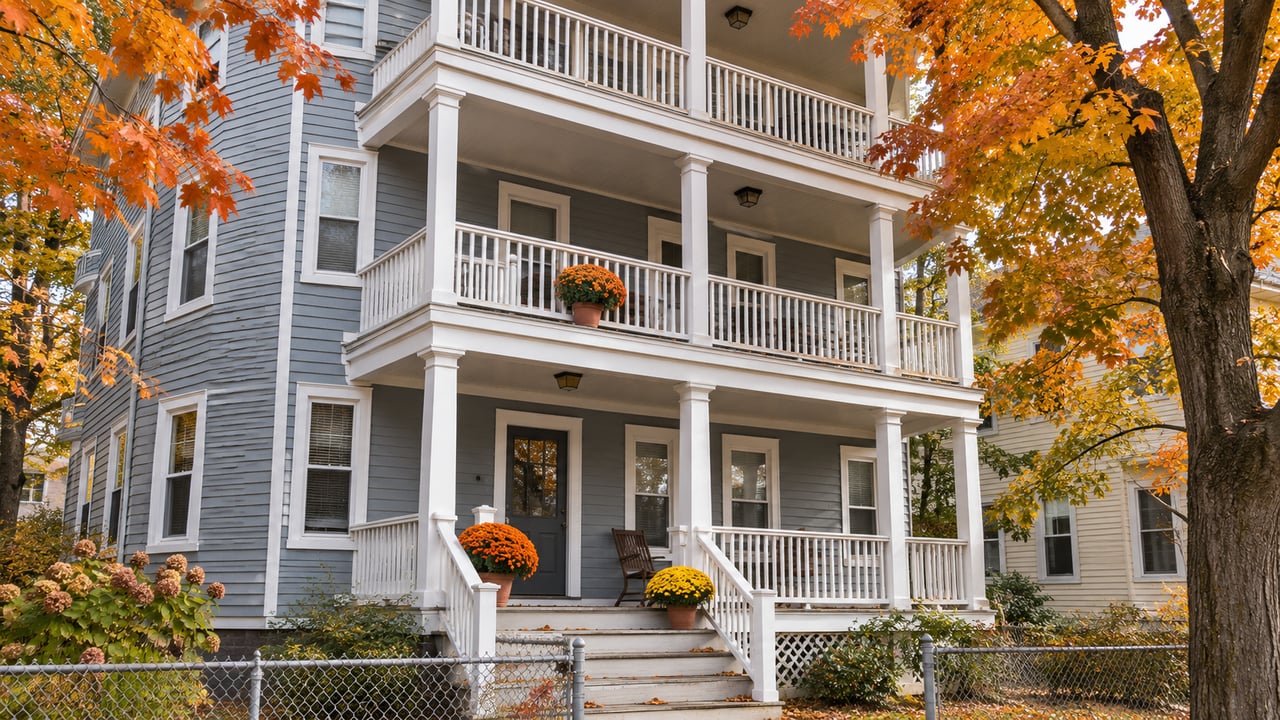
The program fits Boston's housing stock well. An estimated 15,000 triple-deckers were built in Boston and surrounding cities between 1880 and 1930, according to the Boston Preservation Alliance. You'll see different versions depending on where you look: mostly flat roofs in South Boston, pitched roofs in Roxbury, and a mix of both in Dorchester, which grew up as a streetcar suburb.
Our take: a three-family with two households in it is a strong setup. Two units are owner-occupied and the third can be rented, which helps everyone carry the mortgage. Just make sure your lender and the city agree on how the rental unit is treated before you write an offer.
What should co-buyers watch out for in an older Boston multi-family?
Lead paint is the big one. Most Boston two- and three-families were built long before 1978, and the Massachusetts Lead Law requires owners to remove or cover lead paint hazards in pre-1978 homes where a child under 6 lives. That applies to owner-occupants and to landlords of the rental unit.
The co-purchasing program adds its own step. For homes built before 1978, the Boston Home Center does a visual paint inspection, and if it finds peeling paint that isn't minor, you have 30 days after moving in to stabilize it.
A few other things to plan for:
- Taxes: if you live there, you may qualify for Boston's residential exemption, which saved owners up to $4,353.74 last fiscal year. The FY2027 filing deadline is April 1, 2027. Here's how the Boston residential exemption works for new homeowners.
- Loan type: the city's page lists FHA loans, but the January 2025 guidelines say FHA is only for individual buyers with the Boston Home Center's approval. Ask an approved lender which product fits your group.
- Exit plan: write down what happens if one household needs to move. It's a lot easier to agree on that now than later.
What this means for buyers
- Line up your co-buyers early. Every household needs its own application, income check, and homebuyer class.
- Shop for vacant or soon-to-be-vacant properties. If there's a tenant in a unit you need, ask how and when it will be delivered empty.
- Start with an approved lender. The city requires one, and they'll tell you what each household can borrow.
What this means for sellers
- Vacancy can widen your buyer pool. If you can deliver two or three units empty, co-purchasing buyers can use the program. Talk to your attorney about timing with any current tenants.
- Have your lead paint paperwork ready. Buyers of pre-1978 homes will ask for it, and so will the city.
- Price it right. Check the latest quarterly numbers in our Warren Report market reports before you set a list price.
Frequently asked questions
Do all co-buyers have to be first-time homebuyers?
Yes. Under the city's guidelines, each household must not have owned a home in the past three years, with a few exceptions such as a former spouse's home after a divorce.
Can family members use Boston's co-purchasing program?
Yes, as long as each buying household is separate and lives in its own unit. A married couple living together counts as one household.
Do I have to pay back the city's co-purchasing loan?
Only if you sell, transfer, or refinance, or if the home stops being your primary residence. It carries 0% interest while you live there.
Can I use the program to buy a four-family or a condo?
No. The pilot only covers two- and three-family homes located in the City of Boston.
How long does the Boston Home Center take to review an application?
The guidelines say staff follow up within five business days of receiving a complete application. Once approved, funds are reserved for 45 days, with a possible 30-day extension.
Thinking about co-buying in Boston?
Co-buying a two- or three-family is one of the more creative ways into the Boston market right now, and it rewards buyers who plan ahead. If you want help finding a property that fits the program, or you're a multi-family owner wondering how to reach these buyers, Berkshire Hathaway HomeServices Warren Residential works with buyers and sellers in Dorchester, Roxbury, South Boston, and across Boston. Reach out to our team here and we'll help you map it out.
This post is general information, not legal, tax, or lending advice. Program details can change, so confirm eligibility with the Boston Home Center.