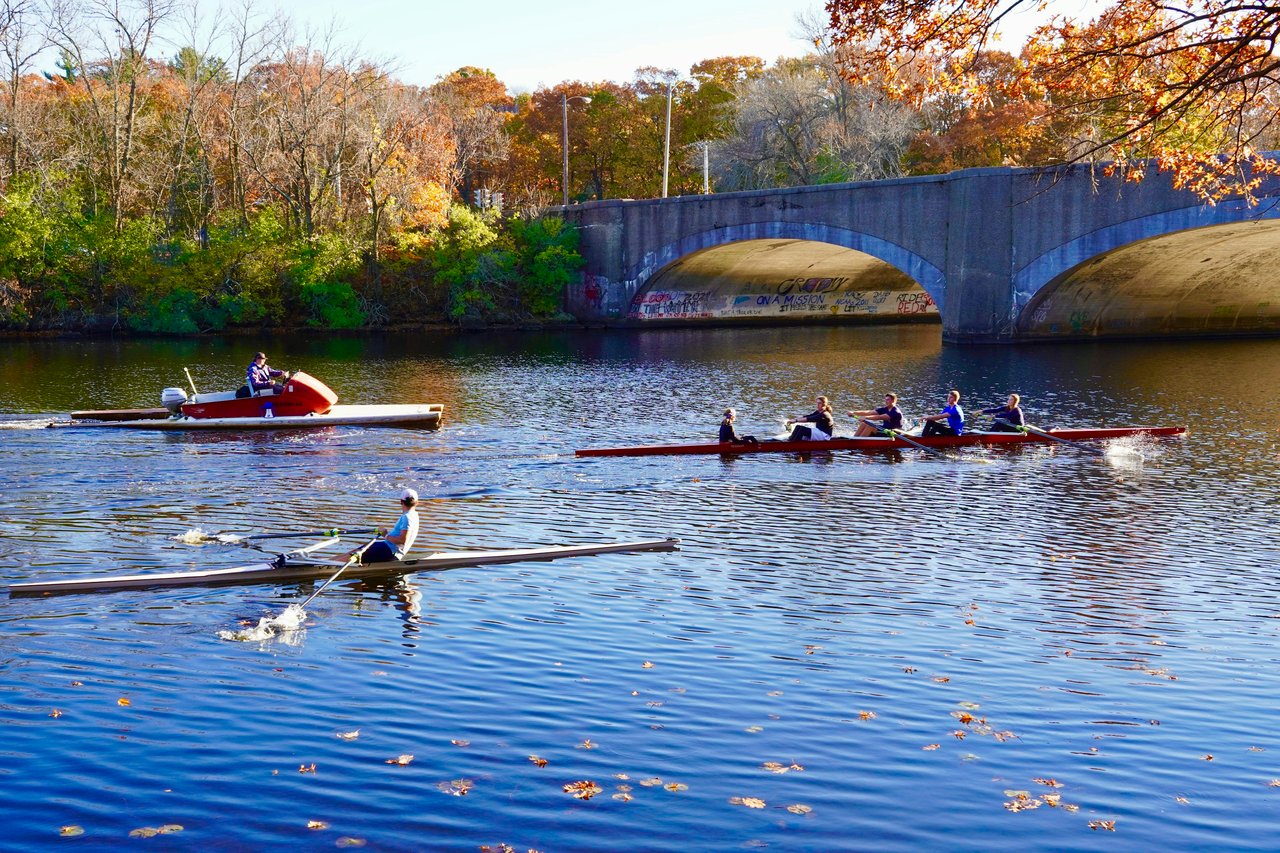
Watertown is a compact town of about four square miles on the north bank of the Charles River, between Cambridge and Waltham. Founded in 1630, it is one of the oldest communities in Massachusetts, and its homes are mostly single-family and two-family houses, along with a growing number of condominium and apartment buildings along Pleasant Street and Arsenal Street.
Watertown was founded in 1630 on fertile farmland along the river. In 1632 its residents refused to pay a colonial tax levied without their representation, an early protest of the kind that later fueled the Revolution. In 1638 Thomas Mayhew built a grist mill at the falls in what is now Watertown Square, and the town grew into a mill village. During the siege of Boston the Provincial Congress moved here in April 1775, and Paul Revere printed currency for the Continental soldiers nearby. The Treaty of Watertown, signed in 1776 at the Edmund Fowle House, was the first treaty between the new nation and a foreign power.
Industry followed the river. The Bemis factory, opened in 1807, wove cotton sailcloth, and the Watertown Arsenal, built from 1816 with buildings designed by Alexander Parris, served the Army for well over a century before it was redeveloped into a park, homes, offices, and shops. Watertown adopted its current charter in 1980 and is still known as the Town of Watertown. It borders Cambridge to the east, Belmont to the north, Waltham to the west, and Newton and Allston/Brighton across the Charles.
Watertown has no subway station, but MBTA buses run from Watertown Square to Harvard station in Cambridge and to Kenmore in Boston, and express buses connect Watertown Yard with downtown. The Massachusetts Turnpike is just across the river at Newton Corner, Main Street carries Route 20 west toward Waltham, and the Charles River paths connect Watertown with Cambridge and Boston by bike or on foot.
Single-family and two-family houses make up about two-thirds of Watertown's homes, and a large share was built before World War II, including many two-family houses with stacked units that are often sold as condominiums. The Mt. Auburn Street Historic District protects older homes along that corridor. Since the 2010s, larger condominium and apartment buildings have been added along the Pleasant Street and Arsenal Street corridors, many close to the river.
Watertown buildings on our site include:
Watertown Square is the traditional center, with restaurants, shops, and the Armenian Museum of America, whose collection of more than 25,000 artifacts is the largest in the Armenian diaspora. Coolidge Square and Main Street have their own neighborhood businesses, and the former Arsenal grounds hold a 13-acre park, the Mosesian Center for the Arts, and the Commander's Mansion, a town-owned event venue. Mount Auburn Cemetery, the first garden-style cemetery in the country, opened in 1831 on the Cambridge line and is the largest open green space in Watertown. The Charles River paths follow the riverbank past the dam at Watertown Square.
What kinds of homes are in Watertown?
Single-family and two-family houses make up about two-thirds of Watertown's homes, and many two-family houses with stacked units are sold as condominiums. Since the 2010s, larger condominium and apartment buildings have been added along the Pleasant Street and Arsenal Street corridors, many close to the river.
How do you get to Boston from Watertown?
Watertown has no subway station, but MBTA buses run from Watertown Square to Harvard station in Cambridge and to Kenmore in Boston, and express buses connect Watertown Yard with downtown. The Massachusetts Turnpike is just across the river at Newton Corner.
What is at the former Watertown Arsenal?
The Watertown Arsenal, built from 1816 with buildings designed by Alexander Parris, served the Army for well over a century before it was redeveloped into a park, homes, offices and shops. The grounds hold a 13-acre park, the Mosesian Center for the Arts and the Commander's Mansion.
To see homes for sale in Watertown, browse the listings below. Thinking of buying or selling in Watertown? Call (617) 848-9616 or get a free home valuation. Watertown is part of our Greater Boston guide.
35,620 people live in Watertown, where the median age is 39.3 and the average individual income is $73,788. Data provided by the U.S. Census Bureau.
Total Population
Median Age
Population Density Population Density This is the number of people per square mile in a neighborhood.
Average individual Income
There's plenty to do around Watertown, including shopping, dining, nightlife, parks, and more. Data provided by Walk Score and Yelp.
Explore popular things to do in the area, including Mt Auburn Market, Sweet Cakes Boston, and Convenience Plus.
| Name | Category | Distance | Reviews |
Ratings by
Yelp
|
|---|---|---|---|---|
| Dining | 0.17 miles | 0 reviews | 0/5 stars | |
| Dining | 0.49 miles | 1 review | 1/5 stars | |
| Dining · $$ | 0.65 miles | 8 reviews | 4.6/5 stars | |
| Dining | 0.71 miles | 0 reviews | 0/5 stars | |
| Dining · $ | 0.86 miles | 0 reviews | 0/5 stars | |
| Shopping | 0.91 miles | 0 reviews | 0/5 stars | |
| Active | 0.55 miles | 0 reviews | 0/5 stars | |
| Active | 0.64 miles | 110 reviews | 4/5 stars | |
| Active | 0.78 miles | 0 reviews | 0/5 stars | |
| Beauty | 0.34 miles | 1 review | 5/5 stars | |
| Beauty | 0.35 miles | 0 reviews | 0/5 stars | |
| Beauty | 0.43 miles | 9 reviews | 4.6/5 stars | |
|
|
||||
|
|
||||
|
|
||||
|
|
||||
|
|
||||
|
|
Watertown has 16,399 households, with an average household size of 2.15. Data provided by the U.S. Census Bureau. Here’s what the people living in Watertown do for work — and how long it takes them to get there. Data provided by the U.S. Census Bureau. 35,620 people call Watertown home. The population density is 8,838 and the largest age group is Data provided by the U.S. Census Bureau.
Total Population
Population Density Population Density This is the number of people per square mile in a neighborhood.
Median Age
Men vs Women
Population by Age Group
0-9 Years
10-17 Years
18-24 Years
25-64 Years
65-74 Years
75+ Years
Education Level
Total Households
Average Household Size
Average individual Income
Households with Children
With Children:
Without Children:
Marital Status
Blue vs White Collar Workers
Blue Collar:
White Collar: