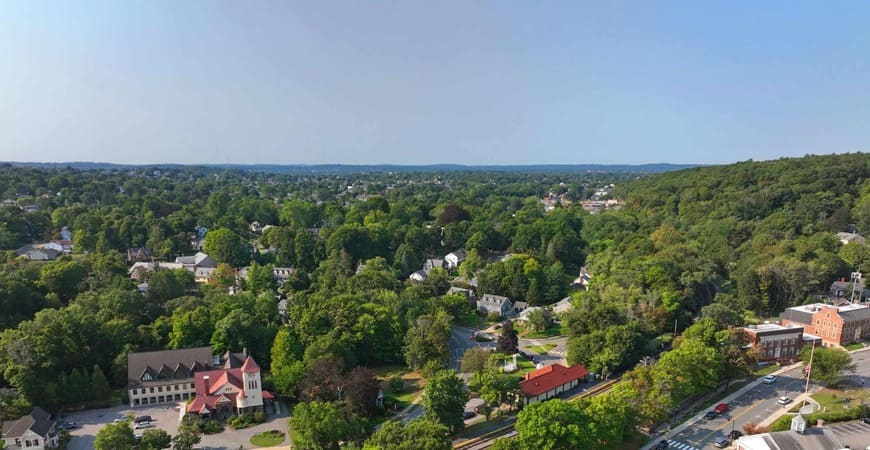
Belmont is a town in Middlesex County just west of Cambridge, known as the Town of Homes because it is almost entirely residential. Its tree-lined streets spread out from three small commercial centers, Belmont Center, Cushing Square, and Waverley Square, and climb toward Belmont Hill in the northwest.
Belmont was created on March 18, 1859, from parts of Watertown, Waltham, and West Cambridge, the town now called Arlington. The railroad came first: the Fitchburg Railroad reached the area around 1843, and villages grew up around the stations at what are now Belmont Center and Waverley. One of the strongest backers of a new town was John Perkins Cushing, its largest taxpayer, who helped pay for incorporation on the condition that the town be named after his 200-acre estate, Bellmont.
The early town was a landscape of fruit farms and market gardens whose celery, tomatoes, and berries were sold at Faneuil Hall market. In 1880 a section around Fresh Pond was annexed to Cambridge. Through the early 1900s the farms gave way to houses, and the town took on the residential character it has today. Belmont borders Arlington, Cambridge, Watertown, Waltham, and Lexington.
The Fitchburg Line commuter rail stops at Belmont station in Belmont Center and at Waverley station in Waverley Square. MBTA bus routes 74 and 75 run from Belmont Center to Harvard, and route 73 connects Waverley Square with Harvard. Route 2 runs along the town's northern edge.
Belmont real estate is mostly single-family and two-family houses, with condominiums in converted houses and smaller buildings near the squares. The town's historic resources survey identified several areas with a distinct character:
Parts of Belmont Center fall within the Pleasant Street Historic District and the Common Street Local Historic District.
Belmont Center is the civic heart of town, with shops and restaurants along Leonard Street and Concord Avenue near the commuter rail station. Cushing Square, where Common Street, Trapelo Road, and Cushing Avenue meet, has early 20th-century commercial blocks, and Waverley Square serves the southwest corner of town near the Waltham line.
Open space is close at hand. Mass Audubon's Habitat Education Center and Wildlife Sanctuary covers 88 acres of forest, meadow, and ponds with walking trails, and the Western Greenway, a 12-mile footpath loop, connects Belmont with Waltham and Lexington.
To see homes for sale in Belmont, browse the listings below or contact Berkshire Hathaway HomeServices Warren Residential.
27,009 people live in Belmont, where the median age is 42.4 and the average individual income is $92,602. Data provided by the U.S. Census Bureau.
Total Population
Median Age
Population Density Population Density This is the number of people per square mile in a neighborhood.
Average individual Income
There's plenty to do around Belmont, including shopping, dining, nightlife, parks, and more. Data provided by Walk Score and Yelp.
Explore popular things to do in the area, including Star K, Economics Studies, and Sand Janet Psycholgst.
| Name | Category | Distance | Reviews |
Ratings by
Yelp
|
|---|---|---|---|---|
| Dining | 0.81 miles | 2 reviews | 3/5 stars | |
| Active | 0.25 miles | 0 reviews | 0/5 stars | |
| Active | 0.32 miles | 0 reviews | 0/5 stars | |
| Active | 1.03 miles | 0 reviews | 0/5 stars | |
| Beauty | 0.25 miles | 4 reviews | 4/5 stars | |
| Beauty | 0.77 miles | 0 reviews | 0/5 stars | |
| Beauty | 1.06 miles | 0 reviews | 0/5 stars | |
|
|
||||
|
|
||||
|
|
||||
|
|
||||
|
|
||||
|
|
Belmont has 10,358 households, with an average household size of 2.59. Data provided by the U.S. Census Bureau. Here’s what the people living in Belmont do for work — and how long it takes them to get there. Data provided by the U.S. Census Bureau. 27,009 people call Belmont home. The population density is 5,812 and the largest age group is Data provided by the U.S. Census Bureau.
Total Population
Population Density Population Density This is the number of people per square mile in a neighborhood.
Median Age
Men vs Women
Population by Age Group
0-9 Years
10-17 Years
18-24 Years
25-64 Years
65-74 Years
75+ Years
Education Level
Total Households
Average Household Size
Average individual Income
Households with Children
With Children:
Without Children:
Marital Status
Blue vs White Collar Workers
Blue Collar:
White Collar: