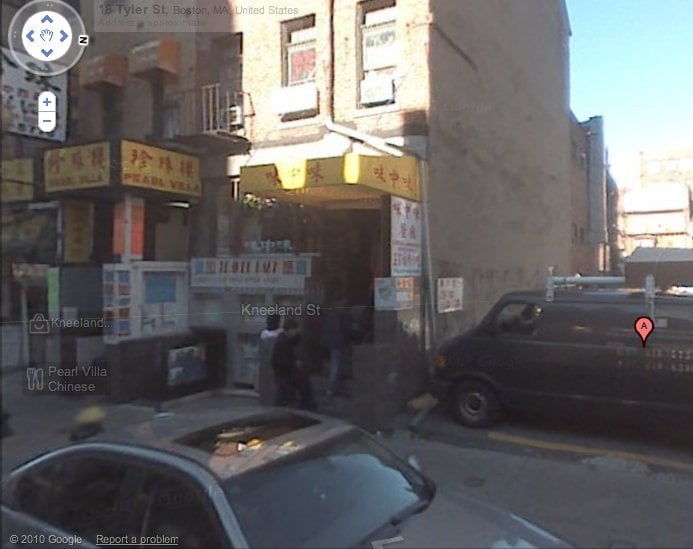
Chinatown is a compact downtown Boston neighborhood centered on Beach Street, Harrison Avenue, Tyler Street and Kneeland Street, and it is the last historic Chinatown in New England. It lies between the Theater District and Downtown Crossing to the west and north, the Leather District and South Station to the east, and the South End to the south, with the Rose Kennedy Greenway along its eastern edge.
Much of Chinatown stands on land made in the early 1800s by filling tidal flats in the South Cove, the area between Downtown and the South End. Federal-style brick row houses went up near the new rail yards and wharves, and after South Station opened nearby the South Cove became home to a succession of immigrant enclaves. Chinese settlement began in the 1870s, after workers recruited from California for a shoe factory in North Adams made their way to Boston. Laundries, groceries, restaurants and village associations grew up in the South Cove, even under the Chinese Exclusion Act of 1882, which stayed in force until 1943.
The 20th century reshaped the neighborhood. Construction of the Central Artery in the 1950s and the Massachusetts Turnpike in the 1960s took blocks of row houses on Kneeland, Hudson and Albany Streets, and the growth of the medical center now known as Tufts Medical Center absorbed more land. The Chinese Merchants Association building at Kneeland and Hudson Streets still shows where part of it was cut away for the highway. After the Big Dig, Chinatown Park opened on the Greenway, designed by Kongjian Yu with Carol R. Johnson Associates, and the ornamental paifang gate at the foot of Beach Street stands at its southern end.
Chinatown and Tufts Medical Center stations on the Orange Line serve the neighborhood, and the Silver Line runs along Washington Street with a stop at the Chinatown Gate. South Station, with the Red Line, commuter rail and Amtrak, is a few blocks east, and the Massachusetts Turnpike and Interstate 93 run along the neighborhood's edge.
Housing in Chinatown ranges from 19th-century brick row houses, which survive in pockets on Hudson, Tyler, Oak and Pine Streets and Johnny Court, to mid-rise and high-rise apartment and condominium buildings, including a number of income-restricted homes. Many older buildings have shops and restaurants at street level with homes above.
Chinatown does not yet have building pages on our site, but several nearby buildings do, including The Radian on the Greenway, 660 Washington beside Chinatown station, and The Kensington on Washington Street. Loft buildings in the neighboring Leather District are covered on that neighborhood's page.
Chinatown is one of Boston's best-known dining destinations, with restaurants, bakeries and grocery markets packed into a few blocks of Beach Street, Tyler Street and Harrison Avenue. Chinatown Park hosts Lunar New Year celebrations and lantern festivals, and lion dances move through the streets each Lunar New Year. Boston Common, the theaters of Washington and Tremont Streets, and the shops of Downtown Crossing are a short walk away, as is Bay Village.
What kinds of homes are in Chinatown?
Housing ranges from 19th-century brick row houses on Hudson, Tyler, Oak and Pine Streets and Johnny Court to mid-rise and high-rise apartment and condominium buildings, including a number of income-restricted homes. Many older buildings have shops and restaurants at street level with homes above.
How do you get around from Chinatown?
Chinatown and Tufts Medical Center stations on the Orange Line serve the neighborhood, and the Silver Line runs along Washington Street with a stop at the Chinatown Gate. South Station, with the Red Line, commuter rail and Amtrak, is a few blocks east.
Where is Chinatown Park?
Chinatown Park is on the Rose Kennedy Greenway along the neighborhood's eastern edge, opened after the Big Dig. The ornamental paifang gate at the foot of Beach Street stands at its southern end, and the park hosts Lunar New Year celebrations and lantern festivals.
To see homes for sale in Chinatown, browse the listings below. Thinking of buying or selling in Chinatown? Call (617) 848-9616 or get a free home valuation. Chinatown is part of our Boston neighborhood guide.
4,584 people live in Chinatown, where the median age is 45 and the average individual income is $36,159. Data provided by the U.S. Census Bureau.
Total Population
Median Age
Population Density Population Density This is the number of people per square mile in a neighborhood.
Average individual Income
There's plenty to do around Chinatown, including shopping, dining, nightlife, parks, and more. Data provided by Walk Score and Yelp.
Explore popular things to do in the area, including Jia Ho Supermarket, Da La Pi, and White House II.
| Name | Category | Distance | Reviews |
Ratings by
Yelp
|
|---|---|---|---|---|
| Dining · $ | 0.17 miles | 52 reviews | 3.4/5 stars | |
| Dining | 0.18 miles | 0 reviews | 0/5 stars | |
| Beauty | 0.12 miles | 1 review | 5/5 stars | |
| Beauty | 0.2 miles | 22 reviews | 3.2/5 stars | |
|
|
||||
|
|
||||
|
|
||||
|
|
||||
|
|
||||
|
|
Chinatown has 2,360 households, with an average household size of 2. Data provided by the U.S. Census Bureau. Here’s what the people living in Chinatown do for work — and how long it takes them to get there. Data provided by the U.S. Census Bureau. 4,584 people call Chinatown home. The population density is 51,350 and the largest age group is Data provided by the U.S. Census Bureau.
Total Population
Population Density Population Density This is the number of people per square mile in a neighborhood.
Median Age
Men vs Women
Population by Age Group
0-9 Years
10-17 Years
18-24 Years
25-64 Years
65-74 Years
75+ Years
Education Level
Total Households
Average Household Size
Average individual Income
Households with Children
With Children:
Without Children:
Marital Status
Blue vs White Collar Workers
Blue Collar:
White Collar: